5 things to know about the Norwegian healthcare system as a newcomer
When you move to Norway, there are a lot of practical systems to learn—banking, housing, taxes, and, of course, the healthcare system. And if you grew up in a very different system, it can take a moment to understand how things work here.
I didn’t grow up with a socialized public healthcare system like this. So I say this with my full chest: I love Norway’s healthcare system!
The safety net, the equity, the accessibility. Even when it’s imperfect or slow, the principle behind it is something worth valuing.
Experiences with the Norwegian healthcare system can vary greatly
Experiences with healthcare vary widely—even among people who live in the same city!—and it also depends on what you’re comparing the Norwegian system to. Some feel incredibly supported. Others find the system slow, rushed, or hard to navigate. Both can be true at the same time.
Here are some reflections shared by our community, showing how different it can feel depending on your background, expectations, and personal situation:
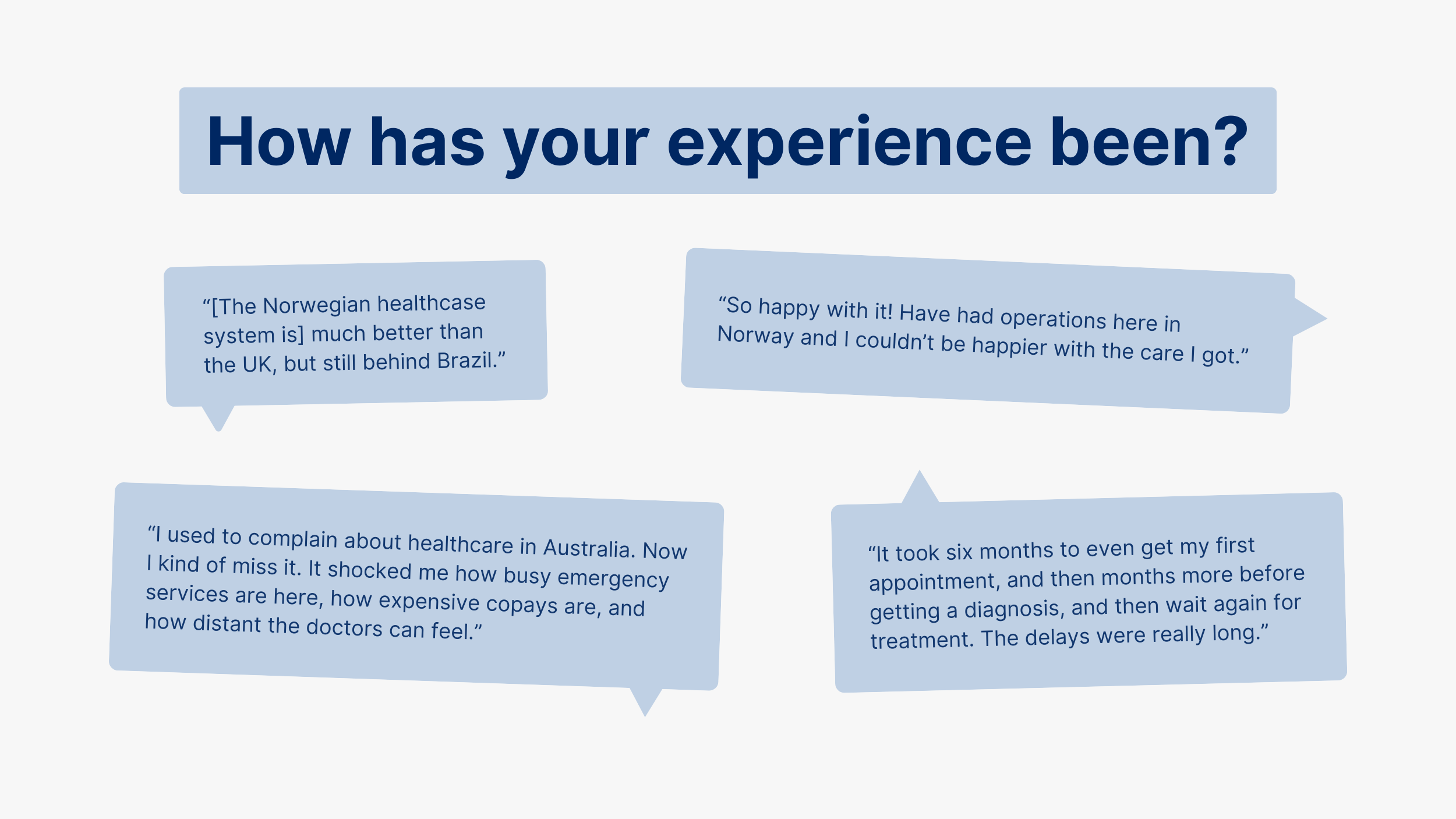
Some reflections shared by the Unlock Norway community via Instagram, showing how different it can feel depending on your background, expectations, and personal situation.
And it’s completely normal to feel confused at the beginning. Most of us learn by doing: going to the doctor for the first time, scheduling our first appointment, or trying to understand why pharmacy receipts look like itemized poetry.
Please note that this is not intended to be a super comprehensive post that covers every single detail of the Norwegian healthcare system, but rather shares five things that may not be obvious and that we wish we knew sooner.
1) Healthcare in Norway isn’t free (but it is affordable)
Most doctor appointments and treatments come with a small copay (called an egenandel). You pay this every time you visit your fastlege (General Practitioner / GP), specialist, psychologist, or when you pick up certain medications.
However, once your copays add up to a certain thresshold per calendar year (3,278 NOK in 2025), the system gives you something called a frikort (“free card”). After that, many eligible treatments and medications become free or heavily discounted for the rest of the year.
You don’t need to track the receipts yourself—it’s automatic. If you become eligible, you’ll get a notification digitally or in the mail. You should keep a copy of frikort easily accessible, but it should also be automatically applied in online systems.
2) You don’t have to stay with the same doctor
When you register your address in Norway, you’re automatically assigned a fastlege (GP). But you are not stuck with them forever!
You can switch up to 2 times per year through Helsenorge.no. You can also view which doctors have availability in your area and join waitlists.
Finding a fastlege who listens and communicates well can make a huge difference, so don’t be afraid to switch.
3) There’s a difference between the Legevakt and ER
This is one of the most confusing parts at first:
Legevakt (urgent care): When something can’t wait for a regular appointment, but isn’t life-threatening. Example: infection, fever, injury, severe pain.
Akuttmottak / Emergency Room: For life-threatening emergencies only. Example: trouble breathing, chest pain, severe trauma.
If you’re unsure, call 116 117 (urgent care hotline). For emergencies: 113.
Figuring out the healthcare system can require some “learning by doing.”
It takes time to understand how everything works, and that’s okay!
4) Dental care works differently
For children, dental is free (up to age 18, sometimes partly covered until 26). For adults, dental is private and can be expensive.
It’s completely normal in Norway to ask for pricing in order to compare clinics, and switch dentists.
For something sudden (cracked tooth, severe pain), search for tannlegevakt (emergency dentist).
5) Specialists mostly requirer referrals (and patience)
If you need a dermatologist, neurologist, ENT, gynecologist, etc., your fastlege usually needs to refer you. Wait times can vary from a few weeks to several months, depending on your condition, location, and clinic capacity.
You can choose private care to skip the queue, but that could be more expensive.
If your case becomes more urgent, you can also ask your doctor to update your referral priority.
Still confused? Don’t worry, you’ll figure it out.
God bedring & lykke til! 💛 (“Get well soon” and “good luck” are two phrases you’ll hear a lot here.)
Still adjusting to life here? You’re in good company. Join our monthly newsletter for more insights into life in Norway.